

by
Clay Frohman
Fretboard Journal
November
2025
Original article: 



click to enlarge
On a bright sticky Saturday in early May 1995, I was sitting with friends near the front of the main performance stage at the New Orleans Jazz and Heritage Festival. We were waiting for Joni Mitchell to come on. She was headlining the closing weekend, a coveted slot, but freighted with even more anticipation than usual because (a) Joni hadn't toured since 1983, more than a decade ago, due in part to the impracticality of adjusting her many tunings between songs or carrying enough guitars and techs to handle it all, and (b) word had circulated that today's show might be her swan song, a final public performance before she called it quits on the "star-making machinery" of the music business, toward which she had for years harbored a simmering antipathy.
Thousands of music fans and Joni fanatics filled the sprawling lawn behind me. Joni's career spanned many eras, genres and styles and they were all reflected in the mix of folkies from the "Circle Game" and "Both Sides Now" early years, reverent intimates from the probing confessional Blue and For The Roses period, pop fans from Joni's commercial breakthrough Court and Spark and beyond. As her thirst for new sounds evolved from the solo folk guitar and dulcimer of Song To A Seagull and Clouds into more complex and rhythmic band arrangements, Joni sought out schooled jazz musicians like Jaco Pastorius, Wayne Shorter and Tom Scott who could work through her unorthodox chord voicings and add their own swing and sass to the challenging music heard on The Hissing of Summer Lawns and Hejira. As an artist, Joni had always thrived on risk and experimentation, and always pushed forward with a stubborn velocity, sometimes to the detriment of record sales and industry backlash, as evidenced in her collaboration with dying jazz eminence Charles Mingus on her album Mingus. To the critics and company suits and even her own management team, it just wasn't a "Joni record," but no matter; Joni did it for herself, and for Charlie.
Not all of Joni's fans kept up with her jazzier enthusiasms, but I did. Having come of age as a rock guitarist mainlining Beatles, Motown and my hometown Chicago blues, I was introduced in elementary school to Miles, Bill Evans and Herbie Hancock's Maiden Voyage by my best friend, a budding clarinet prodigy who dove deep into jazz and brought me along. I walked around the schoolyard humming the bass line to "Bitches Brew" and feeling like a Major Dude. When I moved to Los Angeles after college, one of my first gigs was writing liner notes for Blue Note, the premier jazz label in town. I worked for the label on album projects with Chick Corea, Ronnie Laws and, yes, Wayne Shorter. So, Joni's jazz direction suited me. She was playing with half of Weather Report! How cool was that for the Woman of Heart and Mind?
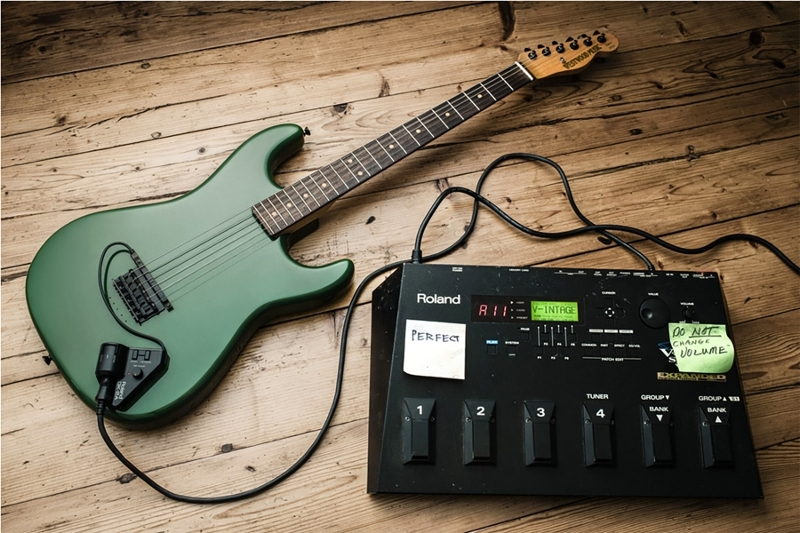
As I was relating some of this personal history to my friends on the Jazz Fest lawn, Joni stepped on stage with her luminous smile, wearing a broad-brimmed straw hat, cradling a curious green Strat-shaped electric guitar that appeared to have no pickups or volume controls save for a block of black plastic near the bridge. The crowd greeted her with cheers and applause. Joni announced, "I'm going to try something new today."
She launched into "Sex Kills" from her album Turbulent Indigo. But something was off. The sounds coming from the green guitar were drenched in delay and reverb, distorted and unintelligible. There was a palpable uncertainty in the crowd. This didn't sound like the music they expected, like nothing they recognized. And what was this strange green guitar under her fingers? It barely sounded like a guitar at all. More like a rude synth.
Joni pushed on, into "Moon at the Window" from Wild Things Run Fast. The guitar sound still wobbled wildly out of control. From where I sat, the crowd energy had turned against whatever new thing Joni was trying to do. A couple behind me collected their lawn chairs and left.
I looked on in dismay. I knew the backstory of Greenpeace.
THERE IS A SERIES of photographs of a young Joni, David Crosby and Eric Clapton taken in the backyard of Mama Cass Elliot's Laurel Canyon home back in the late '60s. Joni is new to the scene, having been brought to Los Angeles by ex-Byrd Crosby after he was entranced by a set she played in a Florida folk club. She sits cross-legged on the lawn playing her D-28, and the dour Clapton is focused hard on her, trying to decipher how these incredible songs and sounds are coming from this stunning blonde Canadian with a Martin guitar. He's watching her hands for familiar chord shapes but there are none.
Clapton was stumped because Joni Mitchell was no ordinary guitar player. Her approach to the instrument was entirely of her own design. After picking up her first chords, as many did, with Pete Seeger's The Folksinger's Guitar Guide, Joni found Elizabeth Cotten's fingerpicking style, then migrated to blues tunings and the more traditional open tunings, then began to invent tunings and voicings based on what sounded interesting to her ear in the moment. She would tune to numbers in a date, to a piece of music on the radio, to the environment she found herself in, to birdsong. Her process was one of invention, discovery, a breezy disregard for traditional forms. With her longtime guitar tech and archivist Joel Bernstein, she created a numerical notation system to keep track of her tunings and which songs they were assigned to.
In an interview with Jeffrey Pepper Rodgers for a songbook titled Joni Mitchell Complete...So Far, Joni likened her use of continually changing and creating new tunings to sitting down at a typewriter on which the letters are rearranged each day. "It's inevitable that you get lost and type some gibberish," Joni said. "And those mistakes are actually the main reason to use this system; to discover something through error. If you only work off what you know, you can't grow. You have to set up a situation with a random element, to surprise yourself."
Westwood Music owner Fred Walecki, who has helped Joni pursue her sonic ambitions since she first arrived in Los Angeles, told me that she would create a new tuning simply by changing the strings on her guitar. "She would tune to a note she liked," said Fred, "then put on the next string and tune it to a note she agreed with, and it agreed with the first note, and so forth. I once asked her about a specific tuning, and she told me it was the first six notes of 'Starlight Gets in Your Eyes'."
Joni's radical tunings were inextricably linked to her style of composing. One sound she discovered opened a melodic door to the next. Her approach wasn't necessarily to the guitar; it was to what she heard as a full orchestra. "The top three strings are my horn section," Joni told Jeffrey Rodgers. "The bottom three were cello and viola, with the bass being indicated but not rooted yet." Her right hand served as an orchestral conductor, her strumming like a brush stroke, picking and plucking out clutches of notes, slapping and pushing, giving them a percussive swing.
Joni would eventually amass a total of 51 separate tunings to play the songs in her repertoire. Some tunings occurred in several pitches, and over the years she changed to lower pitches as her voice lowered. But this impulse of compositional invention created new problems. She couldn't approximate her chord voicings in a live setting without being, to her hypercritical ear, slightly out of tune. "She not only has perfect pitch," said Fred Walecki, "her ears are more attuned than other musicians. She's very concerned about pitch and intonation. So she was continually dissatisfied with her live sound."
With her live performances becoming increasingly unfeasible, and facing an ever-turbulent music industry that had hardened against what she had to offer, Joni reached the conclusion by the mid '90s that this "latest dance craze" was no longer for her, that she might find more peace and artistic fulfillment staying home with her paints and canvases. She told Fred that she was ready to pull the curtain down on her music career after her upcoming set at the 1995 New Orleans Jazz and Heritage Festival. The Jazz Fest gig would be her last.
But Walecki, an inveterate problem solver, had been aware of his friend's challenges and was already working on a solution.
WAY BACK AROUND 1976, Joni came into Westwood Music with a tape of the electric guitar sound she had developed for her new album, to be titled Hejira. She had been influenced by the sound of Wayne Shorter and Miles Davis playing in near unison on "Nefertiti" and had found a way to emulate that sound by recording her guitar parts three times, one over the other, slightly misaligned, to create a chorus effect before there was such a thing.
She told Fred that Robbie Robertson had asked her to participate in a San Francisco concert he was planning to close out the tenure of The Band. It was to be called The Last Waltz. Joni wanted to debut her Hejira songs at the show and was looking for a way to capture her new guitar tone in a box. Was there such a thing?
The day after Joni dropped off her tape, Fred met with a man named Tom Beckmen on other business. Beckmen was the U.S. rep for a company in Japan named after one of King Arthur's Knights of the Round Table: Sir Roland. The man who created Roland was Taro Kakehashi, an electronics innovator who was responsible for the invention of the drum machine, the first touch-sensitive electronic keyboards, the chorus pedal, and MIDI. "This was the dawning of the age of pedals," said Fred. "There were no chorus pedals or flangers at this point."
Fred gave Joni's tape to Beckmen. Within a few weeks a wooden crate arrived at Westwood Music from Japan. It contained an amplifier with no logo. Soon it would become famous as the Roland JC-120 but at this point it was a prototype, the only one in the world, and it was designed in part for Joni Mitchell. With the chorus feature on this amp, Joni could dial in her Hejira sound. She was thrilled. She took her new amp up to San Francisco to rehearse with Robbie and The Band for The Last Waltz.
Then Fred got a call. Joni was put out. "I need another amp,' she said. "Jaco is plugged into mine and he won't unplug." It turned out the Roland prototype was Jaco's sound as well. Fred told Joni to put Jaco on the phone. In his sternest dad voice, Fred implored the mercurial (and that's a kind word for Jaco's bumptious bullshit) bassist into surrendering his hold on Joni's amp by promising there would be another created for him. And eventually there was, when Fred and Aspen Pittman planted the brains of a JC-120 into Jaco's Acoustic 360 amp.
The innovations from Roland kept coming. Chris Bristol, Vice President for Roland US and another Walecki friend, alerted Fred to a new processor the company was working on called the Virtual Guitar. With this device, which would soon be christened the VG-8, the push of a button would assign each individual string of a guitar to any number of separate tunings. Not only tunings but the processor would allow the user to dial in every parameter in the signal chain, from the type of pickup in the guitar to the size of the speaker in an amp.
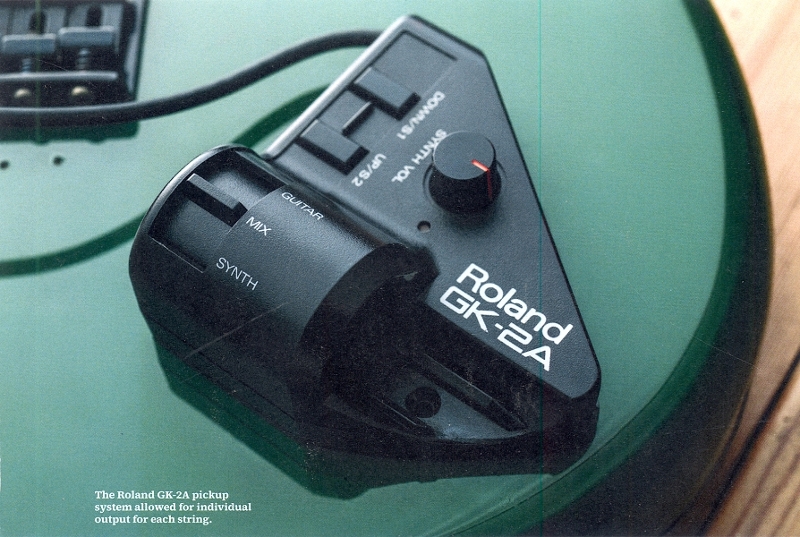
A GK-2A hexaphonic pickup was part of the VG-8 package, to do MIDI interface functions. The pickup had a recording head for each string. Each string would be programmed by the VG-8. The technology would be dubbed COSM. Composite Object Sound Modeling. It would be the first modeler.
When Fred saw what the VG-8 could do, he set about building a guitar for Joni to incorporate the technology. He selected planks of light German spruce at House of Hardwood. The guitar had to be as light as possible as Joni suffered from back problems traced to a childhood bout of polio. Fred glued pieces of spruce together and brought them to his mother's house, where he dried the wood in her oven! He then went to Tom Anderson in Newbury Park to have the wood shaped into a Strat-style body. He had Pat Wilkins paint the finished body in British racing green. After fitting the GK-2A hex pickup to the bridge and a maple neck with a rosewood board to the Strat body, he presented the finished guitar to Joni along with the VG-8.
The guitar fit Joni perfectly. It appealed to her experimental streak. It was mercifully lightweight. With the guitar in standard tuning, she could now access any of her 51 tunings with the push of a button. The VG-8 offered a lush orchestral soundscape in keeping with how Joni saw and formed a chord. Not only that, but the processor in the VG-8 was itself a sound generator Joni would soon employ as a compositional tool, heard prominently on her album Taming The Tiger.
"You've just enlarged my palette," she enthused to Fred. She named the guitar Greenpeace and decided to debut it along with the VG-8 at Jazz Fest. There was some hesitation among the Roland folks. The system was new and untested. It relied on an off-stage tech manually adjusting the tuning on the VG-8 according to Joni's setlist. But Joni would not be deterred.
She asked Fred to come to New Orleans with her and work the Roland system, but Fred couldn't leave his Westwood store for a weekend. Chris Bristol at Roland came up with a solution by drafting a recent tech hire named Gary Cook. "He'd only been with the company two weeks," said Bristol, "and his first gig was to accompany Joni Mitchell to New Orleans. He couldn't believe his good luck."
Fred and Gary Cook spent prep time with Joni and Greenpeace in her LA living room. They loaded her tunings into the VG-8. They contoured the tone according to what Joni wanted to hear, not only from the tuning but the pitch. "She wanted the vibe of a cello on the low E string," said Fred, "and the VG-8 could do that."
Little Feat was scheduled to play the Jazz Fest main stage ahead of Joni, and Fred arranged for Little Feat's front house mixer Robert "Bubba" Selitto to also do Joni's sound. Selitto promised to pick up Joni's latest record Hejira and become familiar with her sound.
Fred instructed Gary Cook to remove all delay and reverb from the VG-8, to let Selitto adjust her sound. Fred guessed that Joni would miss those elements in rehearsal and lean on Cook to add them. "Don't let Joni beguile you," Fred warned.
In New Orleans, the night before the show, Selitto stepped out of a French Quarter club and was mugged, beaten, and sent to the hospital. His replacement mixer for Little Feat was entirely unfamiliar with Joni's sound. There was no time for a soundcheck. Joni had indeed cajoled Gary Cook into adding back her reverb and delay, so when she started into her set on the Jazz Fest main stage, the resulting guitar sound through the VG-8 was a cacophony of mixed signals that didn't come off well. But shit happens.
In the aftermath of the show, Fred Walecki took a call from Joel Bernstein. "It was awful," reported Bernstein, of Joni's set. "It was terrible." Fred grimaced to himself. A pang of guilt for not being there to get things right. Here he'd put the whole thing together with Greenpeace.
Then he got a second call, this one from Joni, who sounded exultant: "It worked!" Yes, she'd been aware of the audience annoyance with the sound glitches, but those would be ironed out. Joni told Fred she'd gotten through her entire set without tuning problems, her "maddening frustrations," as she called them, for the first time in forever, and that was her primary goal. Greenpeace along with the VG-8 represented a step into the digital future for her, a new set of sounds, a way to move forward.
As Joni explored the sampled sounds she could access from Greenpeace and the VG-8, it stimulated her to compose new music. Her first VG-8-inspired track, titled "Harlem in Havana," was written in standard tuning due to a technical issue with the VG-8's samples. It was a rich irony not lost on Joni, who hadn't played in standard tuning since her early formative days. "I don't know how to play in standard tuning," Joni said, "so I treated standard tuning like it was a new tuning and used my same repertoire of chord shapes."
When Joni's new album, Taming The Tiger, appeared, the back cover acknowledgments included a special thank you to Fred Walecki, "for rekindling my desire to make music."
JAZZ FEST WAS OVER, and the next day, a Monday, I stood at the gate in the New Orleans airport waiting to catch my flight back to Los Angeles. And there was Joni, quietly waiting for the same flight. Next to her was Gary Cook, the Roland tech, but Joni was standing alone. As de rigueur in LA entertainment circles, everybody keeps proper intervals around the legendary ones, but in this moment something propelled me to step forward and introduce myself, a friend of Fred's, and tell her how much I enjoyed her set despite the tech mess, which I was sympathetic to knowing the origin of Greenpeace.
Joni blossomed into that smile and took hold of my hand. "You're such an angel," she said. "You're such an angel." She kept on saying it over and over and I kept on standing there. She held onto my hand long past the point of my being self-conscious about it, and then our flight was called and the seeming trance between us evaporated. We all flew back to LA I barely needed the airplane I was flying so high.
Copyright protected material on this website is used in accordance with 'Fair Use', for the purpose of study, review or critical analysis, and will be removed at the request of the copyright owner(s). Please read Notice and Procedure for Making Claims of Copyright Infringement.
Added to Library on January 15, 2026. ( 63)
Translate this page:
Follow Joni Mitchell



Comments:
Log in to make a comment