

by
Mick Brown
The
Guardian
April
22,
1983
Original article: 
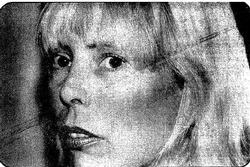
It would be an exaggeration to describe Larry Klein as a hated man; but, face it, there must have been times when he has felt the faintest prickling heat of resentment on his neck. But then that is what comes of marrying the mythic love object of a generation. If you marry Joni Mitchell a lot of people are going to take it badly.
Since she made her first record as an unknown Canadian folk singer in 1968, Joni Mitchell's heart has seemed very much in the public domain, and it should be no surprise that some should have claimed it for their own - if only in the privacy of their own homes. Her songs have been confessional to the degree where listening to Joni Mitchell has often seemed tantamount to entering into a relationship with her — if only by proxy. She has made out of her emotions with an uncommon, some might say indecent candour and insight.
For years her songs exuded a sense of quest, largely unfulfilled. And it came as some surprise when last year she married Klein, a 26-year-old bass-player who had been working with her on the sessions for her most recent album, WILD THINGS RUN FAST. The effect was immediate. Quite her happiest record ever. Is this why the critics have reacted like jilted suitors?
"Somebody in America wrote quite snottily that there were 57 or something times that the word 'love' came up on the album, and he found that a reason to dismiss it, like it was redundant or something," she says with a laugh. "And there a number of people wrote 'Get miserable'...That opinion arose several times. Actually, I think one person wrote it, and three more copied it..."
Mitchell, one senses, does not have a particularly high opinion of the press. There was, she admits, a period in her career when she felt they — and the music industry as a whole — were conspiring to push her out of music altogether, and she almost went. "To stand up there and tear the clothes off your soul is a delicate thing; and you need a certain amount of affection to sustain the desire to do that. If I get too much negative commentary it's very easy for me to raise a finger. I have other things I like to do."
It was her disenchantment with the industry, a sense of being displaced by changing mores and values which largely prompted her unofficial unannounced but nonetheless emphatic retirement from music three years ago, following the release — and commercial failure — of her album MINGUS: her collaboration with, and tribute to, the legendary jazz composer Charles Mingus.
That in itself was a critical album for Mitchell; the ultimate consummation of her interest in jazz which had proved progressively influential in her music over the last few years, taking her steadily, but inexorably, away from the folk-based music with which she had made her reputation in the early Seventies.
Mingus, who was at the time dying from multiple sclerosis, had been persistent about the collaboration. He had presented two ideas: for Mitchell to record an acoustic guitar piece with orchestra, and to condense TS Eliot's The Quartets into street language, but she had balked at both of them. Finally, she says, he presented her with six melodies, titled Joni 1 to 6. "And he had me by flattery. It became a question of me interpreting his wishes. He would give me a theme — 'This one is about the things I'm going to miss,' he'd say, and then he'd look at me real wrily, like Rumpelstiltskin, and say 'Go ahead, figure it out.' It was like he was toying with me, but it was a challenge."
She responded to it painstakingly, and when she had finally finished she believed she had made a record that at least represented her desire to be true to Mingus, and to strike new ground for herself without adhering to the formal jazz tradition. A brave experiment, although Mingus died shortly before the project was complete.
She had expected a mixed reaction, but the response, when it came, took her aback. It was received poorly by the critics; retailers were uninterested; and the one American radio station that played it frequently, she recounts with a gallows smile, switched to a country and western format soon afterwards. "Politically it was unmerchandisable, and that surprised me. I hadn't realized the business had become so political, and that it would be so radically dismissed in every way."
"But the thing that hurt me most was the frequent use of the word 'pretentious'. It hurt me on a personal level, because I didn't believe it was; and on a cultural level, because in my optimism I thought my opportunity for expansion could be a shared thing, but that wasn't the case."
If nothing else, she adds wrily, MINGUS did at least give her a taste of jazz obscurity. But the experience of being cold-shouldered by the record business, and to a large extent her audience, was clearly a sobering one.
Most significantly, the album was a sign of how far she had moved from the centre of the pop mainstream, and how unfamiliar to her that had become. When she looked at the charts she realized she knew none of the names on it. "A lot of my contemporaries were going grey with the new wave, trying to survive," she says. "I thought, I'll just sidestep this entire mess..."
She began to lead the life of refinement, leisure and personal whim which years of hard work, not to mention extravagantly large royalty cheques, had prepared her for. Having always toyed with painting she began to work hard at her canvases. She spent much of her time in New York, going to clubs, dancing. When she began to think about recording again the jazz abstractions of MINGUS no longer seemed so attractive, although she worried that her record company would insist she work with a producer "to keep me in line."
"I called up the president of the record company and said 'You'll be happy to hear my music is headed in a more rock and rollish manner'. you'd think he would be delighted, but to his great credit he said, 'Oh no, don't do that: they'll know...'" she laughs now, as she probably did then. But she changed record companies anyway, and produced the record herself.
And indeed, WILD THINGS RUN FAST is a return to more orthodox ground, to the accessible melodies and sharp lucid arrangements of old, and to lyrics which address with characteristic penetration the dilemmas of growing older in a young person's world, and more enthusiastically, life with Larry. "In a way," she says, "this was the first album ever where it was easy for me to state an unqualified joy. 'Yes, I do...' Every time in the past when I've gone to write 'Yes, darling I love you' I'd start getting chills, as if to say 'Don't say it; it'll go away.' Always that sentiment would be qualified by 'What if...' My life basically has been a search for a monogamous partnership with a genuine desire for faith in a faithless world. And I just don't have any doubts about this relationship."
It is perhaps ironic that she should have started writing again in an explicitly confessional manner, at a time when the genre is at its least prevalent. The other singer-songwriters with whom she rose through the Sixties and Seventies have all dropped one by one from view. A question of over-saturation by the Me generation, she believes, with the bad confessional songwriters — "The real soap-opera types" — spoiling it for the rest; but also a sign of the times.
Her own position in the light of this is perhaps tenuous. WILD THINGS RUN FAST has restored her to the best-seller lists, but not perhaps as emphatically as in the past. But she has been surprised performing in Japan and Australia to find that many of her audiences actually seem to be younger than they once were.
Her ideal vision, she says, is "orange cockatoo hairstyles sitting next to basic black and pearls." But next year she will be 40 — "the press keeps threatening me with it" — and she is aware that "turning 40 in rock and roll is like turning 64 in any other business."
"But as long as you do it with some dignity, as long as you don't jump on the piano and fall backwards into the audience, I don't see why you shouldn't go on. I don't feel any loss of energy, in fact I probably have more, and as long as the public can bear to listen to my songs."
Copyright protected material on this website is used in accordance with 'Fair Use', for the purpose of study, review or critical analysis, and will be removed at the request of the copyright owner(s). Please read Notice and Procedure for Making Claims of Copyright Infringement.
Added to Library on February 13, 2009. (1516)
Translate this page:
Follow Joni Mitchell



Comments:
Log in to make a comment