

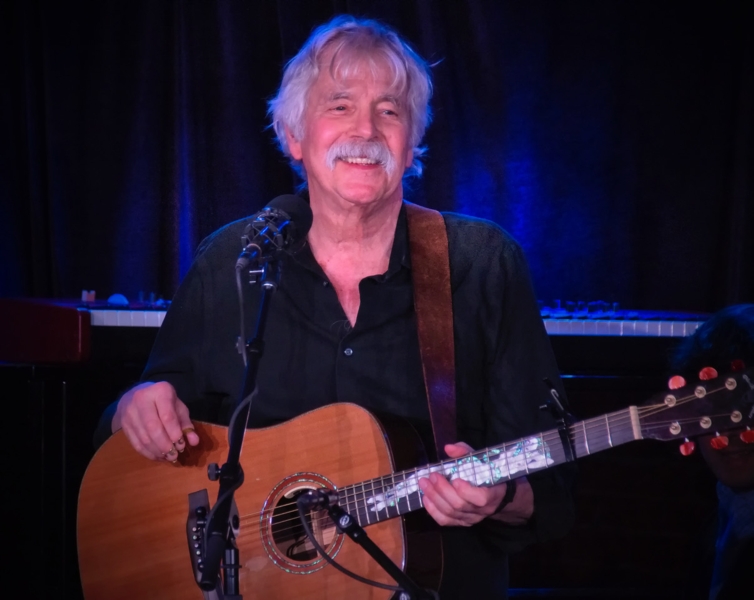
Singer-songwriter Tom Rush comes to Southern California for shows at McCabe’s Guitar Shop in Santa Monica on Saturday, July 25, 2026 and the Coach House Concert Hall on Wednesday, July 29, 2026. (Photo by Lawrence White)
The first two albums Tom Rush recorded for Elektra Records in the mid-’60s mixed the folk music he’d fallen hard for as a college kid in Massachusetts with a little of the rock and roll of his teen years in New Hampshire.
But as time moved on from his 1965 self-titled debut and the 1966 sophomore release, “Take a Little Walk with Me,” Rush felt the pressure, spoken or not, to find new songs for a third album, he says.
“I was really in trouble because I didn’t have any more songs and two years went by,” Rush, 85, says on a recent phone call from New England. “And [Elektra Records founder] Jac Holzman was getting kind of impatient with me.
“Then along came Joni, Jackson and James within six months of each other with these fabulous songs,” Rush says of the then-unknown singer-songwriters Joni Mitchell, Jackson Browne and James Taylor. “They weren’t traditional songs, but I loved them.
“So that’s the basis for the third and last Elektra album, named after Joni’s “Circle Game.”
The timeline here is important, because at the time Rush decided to record Mitchell’s “Tin Angel,” “Urge for Going,” and “The Circle Game,” and Taylor’s “Something In the Way She Moves” and “Sunshine, Sunshine,” those songs had never been recorded by anyone.
Browne’s “Shadow Dream Song” had appeared as an album track on the Nitty Gritty Dirt Band’s 1967 album “Richochet,” but neither he nor Mitchell nor Taylor were known much at all outside of the local scenes from which they came.
“I met Joni in this club in Detroit, Michigan called the Chess Mate,” Rush says. “She got the boss to let her get up and do a five-song guest set, which included ‘Urge for Going,’ which knocked my socks off. I asked her if she had any more new songs and she said, ‘No, but give me a minute.’
“She sent me a tape about six weeks later with six beautiful songs,” he says. “Before the last one, she apologized for the upcoming tune: ‘I just finished this. It’s not much good, I’m so sorry, but here it is.’
“And it was ‘The Circle Game,’” Rush says of a song which became one of Mitchell’s signature tunes when she finally recorded it for “Ladies of the Canyon,” her 1970 third album. “Goes to show artists don’t necessarily know what’s good in their repertoire.”
James Taylor had found limited success, mostly in the Boston to New York City corridor, with the band Flying Machine. But when Rush met him in 1967, he was struggling to find his next move.
“I actually met James kind of sideways,” Rush says. “I was living in Cambridge, and I had a roommate who kept telling me, ‘You got to hear this James Taylor guy, he’s got this band …’. I kept saying, ‘Zach, would you pick up your room, please?’
“Then once I was signed with Elektra, Paul Rothchild, my producer, said, ‘I’m going to set up this meeting with this kid, James Taylor,’” he says. “They set us down on the floor in an empty office room, no furniture, with an Ampex 601 tape recorder.
“And James recorded, I don’t know, four or five songs for me, and then went off to England the next day, and the rest is history,” Rush says. [In London, Taylor was signed to Apple Records by Peter Asher, who produced Taylor’s solo debut, which included both songs that Rush had already released.]
Rush never met Browne at all before he picked “Shadow Dream Song” for the 1968 album “The Circle Game.”
“He wasn’t actually a performer at that time,” Rush says. “He was just a songwriter, and Elektra had his publishing rights. So I had access to his publishing demos. That’s how I ‘met’ Jackson. We’ve gone on to become buddies now, but at the time, he was just a voice and a keyboard.”
Rush is headed to Southern California for shows at McCabe’s Guitar Shop in Santa Monica on Saturday, July 25, the Coach House Concert Hall in San Juan Capistrano on Wednesday, July 29, and the Belly Up Tavern in Solana Beach on Thursday, July 30.
In an interview edited for length and clarity, Rush talked about his definition of a folk song, how he accidentally ended up onstage at his first folk hootenanny, his signature song, “No Regrets,” and more.
Q: So what kind of set do you have planned for your California shows this summer?
A: Well, first of all, I’m going to be bringing a new accompanist with me, a youngster named Brendan Cleary. Everybody should google him; he’s brilliant. I’m very excited about him. I heard him playing in a bar in Boston. I thought, “This kid’s too good to be playing in bars,” so I asked him to come on the road with me, and he’s having a great time.
“We’ll be doing some old favorites, of course, because that’s why people come to shows, to hear the songs they know and love. I’m trying out some new stuff as well, and that’s going over very well, especially one called “It Takes a Lot of Liquor to Love Her.” [He laughs}
Q: Is that on the “Gardens Old, Flowers New” record from 2024?
A: No, I haven’t recorded that yet, but if I get around to doing another collection of funny songs and stories, it’ll definitely be on there.
Q: I know you tell a lot of stories during your shows, too. Does it change from night to night?
A: I kind of respond to the audience. I’m working for them, basically. I realized recently that this is my 68th Annual Farewell Tour. The first time I ever got paid to play music was in Paris, the summer of ’59. That was 68 years ago.
And you’re right, I’ve had a lot of experiences. Some of them funny, some of them only funny in retrospect. But I’ll tell stories about that stuff. About meeting Joni Mitchell when she was a struggling beginner. We have a good time, and yeah, the show does evolve from night to night. I don’t stick to a script.
Q: These are pretty intimate venues, too, so you can interact with people. McCabe’s is probably one of the most intimate places you could play out here.
A: Yeah, it’s true. I love that room. I’ve played there for years and years and years. I’ll be playing a guitar, actually, that I bought from McCabe’s in 1977.
Q: Oh, what kind of guitar is it?
A: It was made by a guy named Don Musser. It was apparently the second guitar Don Musser ever sold. I said, “Who’s this guy?” when I bought the guitar. They said, “Oh, he came in a year ago, and he bought a book on how to build a steel-string guitar, and this is the second one he’s sold.”
“Then I found out that Peter Fonda bought the first one. Recently, someone pointed out to me that Peter Fonda’s Musser guitar was up on eBay, so I bought it. I had the first two guitars Don Musser ever sold, but Peter had signed his name right across it in huge letters so I couldn’t ever really take it on stage. It would take me half the show to explain it. So I passed it on to somebody who appreciates it.
Q: So let me take you back to when you first got interested in playing music. You’d have been a teen in the ’50s when Buddy Holly and Chuck Berry were big.
A: I wanted to be Chuck Berry. But after I did the street singing in Paris, I went to Cambridge to go to college, and it was just full of folk music. All kinds of Harvard students playing Delta blues and Chicago blues and Irish-Scottish ballads all over the place. And I got sucked right into it.
It did occur to me at the time that it was a bit odd having a bunch of Harvard students sitting around singing about how rough it was in the coal mines. We figured we could make up with sincerity what we lacked in authenticity.
Q: Of that type of music, who were the first artists that attracted you? I guess a lot of the songs are traditional, actually.
A: All the songs are traditional. That’s to me what folk music is. If you wrote it, it’s not a folk song, even if your name is Woody Guthrie.
Q: OK, so how’d you begin?
A: I actually had a radio show on Harvard’s little FM station called “Balladeer.” It was like a 30-minute show at 7 p.m. on Tuesdays or something like that. And I had to go out and recruit guests to come on my show.
So I would go to the hootenannies, what they call open mics now, and try to talk people into coming on my radio show. And I discovered pretty quickly you could get in for free if you had a guitar with you. [He laughs] Then I figured out you could get in for free if you just had a guitar case with you. So I would put a six-pack in the guitar case and head off to the hootenannies.
Then I got caught one night at a place called the Golden Vanity. The boss said, “Hey, kid, get on stage, you got in for nothing.” I had to borrow a guitar, and I was terminally nervous, but apparently it went over well enough that the boss kept calling me and asking me if I’d come and substitute for somebody who got sick or canceled. So that was really my first gig.
Q: And you just started playing more around town from that?
A: There was a coffeehouse one block from my dorm in Cambridge called the Club 47, and it was a magical, magical place. They hosted not only the kids, myself included, but they brought in the legends. Sleepy John Estes, the Carter Family, a bunch of the old blues guys.
Which must have been very disorienting for them because most of them are out from the Deep South where they were used to playing with chicken wire in front of the stage because people would throw beer bottles at them.
And here they are in an 80-seat coffeehouse in Cambridge with a bunch of White kids, a lot of them wearing neckties, drinking coffee, and listening with absolute silence. I don’t think they ever experienced anything like that before.
Most of these superstars, in our minds, were very approachable. You could go up to Sleepy John Estes and say, “How do you do that thing you do?” and he’d show you. It was very cool.
Q: I know Club 47 stayed a part of your life for a long time.
A: I inherited the name Club 47 [which, since 1969, has operated as Club Passim] and started doing concerts that featured a couple of well-known artists and a couple of newcomers. “You’ve never heard of these kids, but they’re going to knock your socks off!” It was a way to give these youngsters basically a head start.
Q: I know you had Shawn Colvin and Nanci Griffith, one of my favorites, on a Club 47 bill decades ago.
A: Yeah, she was great. She was on a Club 47 show at Carnegie Hall, I think. Her family came up from Texas and were in the audience, and she was supposed to do a 20-minute set. And at 30 minutes, she was still going strong. I had to just go out after a song and say, “Nanci Griffith!” She was so pissed off at me. [He laughs] But I had other artists; we had a deadline, a curfew.
Q: Back to that night you got busted sneaking in with a guitar case: Do you remember any of the songs you played?
A: Oh, boy. Probably “San Francisco Bay Blues” by Jesse “Lone Cat” Fuller, who also played at Club 47. I don’t remember what else went on. My repertoire has grown enormously in the years since.
Everybody in the local scene was a specialist. People who did nothing but bluegrass, people who did nothing but Delta blues, who did nothing but Irish-Scottish ballads, and I was the generalist. I said, “I like that song, I’ll figure out how to do it,” regardless of the genre. So I was kind of all over the lot.
And I still, even on the latest album - well, I actually wrote all the songs on the latest album - but there’s a couple of up-tempo ones, a couple of sad ones. I’m basically looking for emotional whiplash.
Q: Let me ask you about writing “No Regrets” for “The Circle Game” album. It’s a terrific song, and I think it might be your most-covered song -
A: - Oh, definitely. Definitely. The story behind writing it is kind of odd. I was living in Cambridge. This girl in New York City that I was very excited about flew up to Cambridge and spent the weekend with me. And I had never spent that much time with anybody before, you know, three days and nights.
On Monday, I took her back to Logan Airport to fly back to New York, and it felt strange walking away alone. I went back to the apartment and wrote the song from the perspective of breaking up a long romance, which then did ultimately come true. We had a long relationship that finally dissolved. But when I wrote the song, it was about a weekend, not about half a lifetime.
Q: I know you need to get going, so I’ll bid you farewell -
A: - just make stuff up.
Q: - yeah, I won’t do that. [Laughter]. But I will talk about newest album and songs like “If You Will Love Me,” which particularly got me when I was listening to it. “Glory Road,” too.
A: I think it’s a good thing when different people have different favorite songs off a project. I guess it would be commercially valuable if everybody could agree. But the fact that everybody likes different things is great.
Copyright protected material on this website is used in accordance with 'Fair Use', for the purpose of study, review or critical analysis, and will be removed at the request of the copyright owner(s). Please read Notice and Procedure for Making Claims of Copyright Infringement.
Added to Library on July 22, 2026. ( 47)
Translate this page:
Follow Joni Mitchell



Comments:
Log in to make a comment
alysheba on :
Tom Rush is a national treasure... just go and see his show, you will laugh, sing and marvel at his gift of storytelling