

Subscribe to Larry's Substack here
Joan and I were both what I would have to call compulsive creatives. It's a bit of a funny label to use, as "compulsive" in the psychiatric sense has a negative connotation. I don't mean it in that sense at all. I think that there is a personality archetype, quite common in the arts, that is characterized by the need to be making something in order to feel alive. For many people who see the world through the lens of art, the creative process can be a very effective anti-depressant as well. The consuming forward motion of it somehow has the ability to keep the the darkness at bay. For most of my life it has served as part of a group of elements that combine to form my way of dealing with it.
During the months that we were working on "Night Ride Home" at our home studio I was working on a number of other projects as well. Joni was writing and painting at the same time that we were intermittently working on recording for the album. The house was in constant creative motion, with musicians, friends, and other artists that I was working with coming through. Joan would often come through the door of the studio, coffee and cigarette in hand, to hear what was going on. There was a synergy that was catalytic for the work on what became "Night Ride Home" as well as the other records that I was working on during that period. Musicians that were working on one or another project that I was working on might be recruited to play on either another project or the music that Joan and I were working on. Synchronicity and cross-pollination was commonplace in this situation. Also in that period there were many studios that had multiple rooms. This was a frequent dynamic in these studios. One might run into a musician or artist who was working in another room in the hallway, then drag them in to play something, or sing on something that you were working on your room. This was one of the great features of working in these studios. Many great collaborations happened in this random manner. I miss this.
In thinking about Night Ride Home I've decided to group my recollections, feelings, and observations song by song in the sequence of the album, beginning with the second song, as I've already discussed the title track in the previous Part II
2. Passion Play (When All The Slaves Are Free)
The harmonic structure of this song came to Joan during one of her all-night undulations between painting, playing guitar and jotting down the beginnings of the idea for the lyric in our living room. The writing of the guitar part and the poem was concurrent with the Exxon oil spill in Alaska, where about 11 million gallons of crude oil was spilled into a pristine area of the ocean in close proximity to the Alaskan wilderness. An environmental catastrophe on an unimaginable and shocking scale. This triggered a present tense secular meditation on the nature of religion through the metaphor of Jesus in the parables New Testament for Joan. The lyric contains fragments of a couple bible stories and Nietzchean references that are juxtaposed against the intentionally non-specific reference to the ongoing series of tragic contemporary environmental disasters.
Music And Method
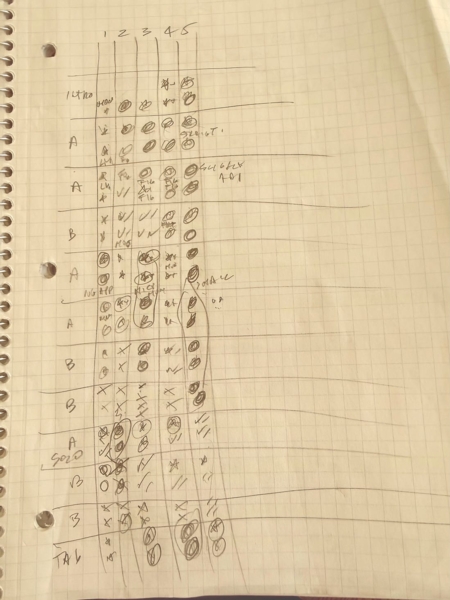
I put together a skeletal percussion fabric for Joan and I to play to. As we did much of the time, we put the guitar and vocal down first, using our usual method of her singing 3 or 4 passes and comping with a grid system that we used for comping instrumental performances, vocals, and anything else. She introduced me to this method. I still use the same system with a notepad and a pencil. Vertical lines divide spaces that denote the track numbers and horizontal lines mark off the spaces for sections of the song. These spaces created are used to evaluate lines of a lyric, 4 bar sections, 8 bar sections or even just entire structural sections (A Section, B Section, Chorus, C Section, Solo etc). She used a simple system of a check, two checks or an X indicating the level of consideration for the final vocal comp. Over the years I've gradually developed a whole language of what looks like a strange kind of hieroglyphic system. The markings and abbreviations indicate different characteristics of vocal phrases or portions of instrumental performances. They give more information for the comp. My system consists of 1 through 3 checks, a star with a plus sign or minus sign, and various other little symbols and marks that indicate other appealing or negative characteristics of each phrase or section. An X still means "not a chance!"
Here's an example of my strange comping system. I'm not sure which project this is from, but it's the first one that I came across. Something relatively recent:
Precision And Elasticity
When I put the initial simple set of percussion sounds together and programmed the 4-bar loop on the Fairlight CMI, it was with the notion that we would end up adding played percussion elements to it. I remember wanting to build a rhythmic texture that had a drive to it that coupled with Joan's guitar, but that didn't utilize shakers, so to leave more of that high-end space in the track for the detail of her guitar part to speak well . Something that had no traditional reference. Something that just felt right. We got Alex Acuña to come in and do a pass of small bongo-like drums, which gave us the blend of rhythmic precision and human inconsistency that we were looking for as a unifying characteristic of the album's drum and percussion approach. I played an electric bass designed to be outfitted with nylon strings that luthier John Carruthers had designed. It had piezo pickups in it's bridge, and was a bass option that worked well if it didn't have to cut through a dense track. This bass braided well with the bottom strings of Joan's guitar. I overdubbed a couple of passes of volume-pedal harmonics and tones with a fretless bass. We used the Fairlight-based multi-sample textural instrument that I had created from various gestures that Bill Dillon had played at different times, our "Billatron", to braid into the volume-pedal bass material, again combining sample/synth-based material with material that had the human textural asymmetry of material that is played.
The Song
Joan would often ask me how I liked a line or which version of a line I preferred. Many times we worked on a song on and off for months and didn't specifically discuss the meaning of lines. These things were a given, as there was almost always a point of origin in our conversations, discussions or debates. I usually knew what sat behind a line as sub-text. I loved this enigmatic poem that she ended up with on this song. Some notes on my way of interpreting the poem:
The opening verse is a vision of a first person account of Mary Magdalene encountering Jesus, and the impact that this had on her. Contrary to general assumptions, she is not referred to as a prostitute in the gospels. It's implied that she is a woman of means, but somewhat of a lost soul. She might have been depressed! She appears in the gospel of John and Mark for the most part:
Magdalene is trembling
Like a washing on a line
Trembling and gleaming
Never before was a man so kind
Never so redeeming
In what you could call the chorus there is a hard cut to what becomes of a great teacher's work when generations and generations of disciples and followers define and re-define the teacher's work. To me "the multitudes" represent all of the generations of followers, including the disciples who wrote the New Testament. Perceptions transmitted by word of mouth, then interpreted, re-interpreted, distorted and re-interpreted. It feels to me that the question posed is what becomes of what might be described as Christian ideals in the world that we now live in. The dilemma of how the principle of all men and women being equal can be reconciled with the fact that someone has to do the work that nobody wants to do. It is a problem that occurs in situations as diverse as a communist construct or a kibbutz:
Enter the multitudes
In Exxon blue
In radiation rose
Ecstasy, now you tell me
Who you gonna get to do the dirty work
When all the slaves are free?
The next verse is centered around the story that is in the gospel of Luke, where Jesus is in Jericho, and Zacchaeus, who is a corrupt tax collector, climbs up in a sycamore tree to be able to see Jesus while he is speaking. When Jesus walks in front of the tree he tells Zacchaeus to come down, as he says publicly that he is going to stay the night at his house. The crowd is incredulous, as they perceive Zacchaeus as a terrible and sinful man. Jesus' point it that this is exactly why he is going to stay with him. In the story Zacchaeus, who is implied to also be of a conflicted nature, is stunned by this gesture. He then becomes a devout follower of Jesus. I perceive the story as a philosophical lesson llustrating how important forgiveness and generous understanding is. It's a particularly beautiful Christian parable.
I am up a sycamore
Looking through the leaves
A sinner of some position
Who in the world can this heart healer be?
This magical physician
Again, how does one reconcile this admirable ideal with the greed, lack of compassion, and shortsighted nature of the business world in the the present construct that we live in?
Enter the multitudes
In Exxon blue
In radiation rose
Misery, you tell me
Who you gonna get to do the dirty work
When all the slaves are free?
The scene changes again, back to the first person account of the Zacchaeus incident, and in the second part of this C Section Joan shifts the perspective and delivers the account as Zacchaeus himself. It makes the poem that much more impactful for her (and therefore the listener who hopefully places themselves in the song) to deliver the last two lines "but he sees a stray in the wilderness, and I see how far I've wandered" in first person. For me these lines are the emotional fulcrum of the poem. They enable the listener to place themselves inside the song.
Enter the multitudes
The walking wounded
They come to this diver of the heart
Of the multitudes
Thy kingdom come
Thy will be done
"Oh, climb down, climb down", he says to me
From the middle of unrest
They think his light is Squandered
But he sees a stray in the wilderness
And I see how far I've wandered
A reiteration of the idea of how far the muti-generational "telephone" phenomenon of religion can get from the core of the teaching. The changing line becomes "apathy", which is a prevalent reaction to the tragic circumstances that we confront in this time with oil spills, climate change. The general environmental catastrophe that has become a backdrop for all of the other existential crises that we are facing.
Enter the multitudes
In Exxon blue
In radiation rose
Apathy, you tell me
Who you gonna get to do the dirty work
When all the slaves are free?
Enter the multitudes
The walking wounded
They come to this diver of the heart
Of the multitudes
Thy kingdom come
Thy will be done
The last verse ties the Nietzchean image of the "flies in the marketplace", a chapter that is an indictment of the heartlessness of ruthless commerce from Also Sprach Zarathustra, with the tragic central event of the New Testament; the violent crucifixion of a rabbi who is espousing forgiveness, generosity, and kindness above all. We were both reading and discussing Nietzsche during the time that we were working on Night Ride Home. Contrary to a popular assumption created as a result of his sister being a fan of Hitler, and an anti-semitic lunatic, Nietzsche was not anti-semitic. He was a harsh critic of everything. The inevitable vicissitudes and shortcomings of the human condition.
Oh, all around the Marketplace
The buzzing of the flies
The buzzing and the stinging
Divinely barren
And wickedly wise
The killer nails are ringing
A reiteration again, this time with a dark, but to my mind realistic and honest substitution of "tragedy" in the changing line.
Enter the multitudes
In Exxon blue
In radiation rose
Tragedy
Now you tell me
Who you gonna get to do the dirty work
When all the slaves are free?
The poem had a cinematic movement to it that I loved, even in the early drafts of it. The undulation between a present tense perspective of Jesus Christ through the lens of two specific biblical parables, and the shift to a non-specific examination of one of most problematic aspects of theology is beautifully structured. We approached working on Joan's musical structure with a mutual desire to also create a non-specific rhythmic texture and a dreamlike frame for her guitar part that would underscore the mystical nature of the poem. We always were searching for fresh ground to turn over.
Copyright protected material on this website is used in accordance with 'Fair Use', for the purpose of study, review or critical analysis, and will be removed at the request of the copyright owner(s). Please read Notice and Procedure for Making Claims of Copyright Infringement.
Added to Library on September 14, 2026. ( 44)
Translate this page:
Follow Joni Mitchell



Comments:
Log in to make a comment